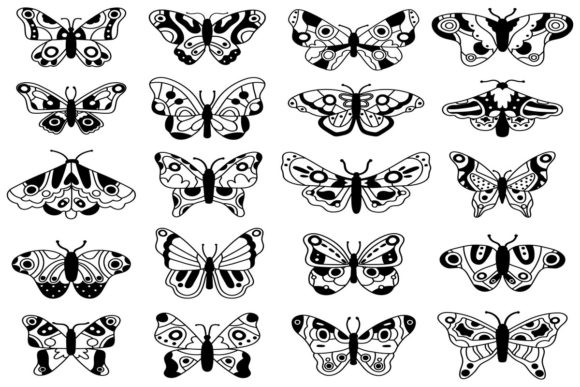
The Artistic Potential of Monochromatic Butterfly Doodles: From Digital Files to Timeless Tattoos
In the vast landscape of digital art and creative design, few subjects capture the imagination quite like the butterfly. A symbol of transformation, beauty, and fragility, these insects have inspired artists for centuries. However, in the modern era of digital creation, the way we utilize these designs has evolved significantly. Enter the monochromatic butterfly doodle collection, a specialized set of artistic assets that bridges the gap between casual sketching and professional application. This article explores what makes this specific type of digital asset so valuable, how it fits into contemporary workflows, and why it is becoming a go-to resource for tattoo artists, graphic designers, and hobbyists alike.
Understanding the Essence of Monochromatic Doodle Art
To fully appreciate the utility of these files, one must first understand the aesthetic philosophy behind them. Monochromatic refers to the use of a single color hue, typically varying only in shade and tone. When combined with a doodle style—which implies a loose, hand-drawn, and often whimsical approach—the result is an image that feels organic yet refined.
Unlike highly detailed, photorealistic renderings or vibrant, multi-colored illustrations, monochromatic doodles rely on line weight, negative space, and texture to convey depth and emotion. This simplicity is not a limitation; rather, it is a strength. It allows the artwork to be versatile. Whether placed on a dark background or a light canvas, the design remains legible and impactful. For the general reader, think of it as the difference between a complex oil painting and a classic charcoal sketch: both are beautiful, but the latter offers a different kind of intimacy and adaptability.
The Significance of Line Work in Modern Design
In an age dominated by flat colors and 3D modeling, there is a growing resurgence of appreciation for traditional line work. The butterfly doodle collection capitalizes on this trend. By stripping away color distractions, the viewer's eye is drawn immediately to the flow of the lines. This focus on structure is crucial for several reasons:
- Scalability: Simple line art can be scaled up to billboard size or down to a ring without losing clarity.
- Versatility: A black-and-white design can be easily recolored later if the client desires a change, offering flexibility that raster images do not always provide.
- Aesthetic Appeal: The elegance of a single-color palette often conveys sophistication, making it ideal for high-end branding or personal expression.
Practical Applications: From Skin to Screen
The primary allure of this specific product collection lies in its dual-purpose nature. It is explicitly designed to serve as elegant tattoo material while simultaneously functioning as a decorative set for art projects. Let us explore how these two distinct fields benefit from such a resource.
Digital Assets for Tattoo Artists
Tattooing is an intricate process where precision meets artistry. For a tattoo artist, having access to a library of pre-drawn, high-quality doodles can streamline the consultation and design phase. The EPS10 file included in this collection is particularly vital here. EPS (Encapsulated PostScript) is a vector format, meaning the graphics are defined by mathematical equations rather than pixels.
This distinction is critical for body art. If an artist were to use a low-resolution JPEG for a tattoo stencil, the lines might appear jagged or blurry when enlarged to fit on a client's arm or back. Vector files, however, can be resized infinitely without any loss of quality. An artist can take a small butterfly doodle and expand it to cover a shoulder blade, ensuring every curve of the wing remains crisp and clean. Furthermore, the monochromatic nature of the design ensures that the tattoo will age gracefully, relying on solid ink density rather than complex color gradients that might blur over time.
Creative Projects and Decorative Sets
Beyond the studio, these digital assets find a home in various creative endeavors. Imagine a graphic designer creating a wedding invitation suite. They need a motif that signifies love and transformation without overpowering the text. A monochromatic butterfly doodle provides the perfect subtle accent. Similarly, interior decorators might use these designs for wall art prints, fabric patterns, or stationery sets.
The inclusion of a 72ppi Resolution JPEG as a preview adds another layer of utility. While the vector file is for editing and printing, the JPEG serves as a quick visual reference. In a fast-paced business environment, being able to quickly show a client a "preview" of the design before purchasing or licensing the full vector file saves time and enhances communication. It allows clients to visualize the final look instantly, facilitating better decision-making.
Navigating File Formats: Why Both Matter
One common misunderstanding among beginners in digital art is assuming that one file format can do everything. This collection wisely includes two distinct formats to address different stages of the creative workflow.
- The EPS10 File: This is the powerhouse of the collection. As mentioned, it is a vector format compatible with industry-standard software like Adobe Illustrator, CorelDRAW, and Affinity Designer. It allows for non-destructive editing. You can change the stroke width, adjust the curves, combine it with other shapes, or export it to any resolution required for print production.
- The 72ppi JPEG Preview: While lower resolution, this file is essential for web use. It loads quickly in email attachments, social media posts, or online portfolios. It gives potential buyers a clear idea of the artistic style without requiring them to download the heavy vector file immediately.
Understanding the synergy between these two files empowers users to work more efficiently. The JPEG gets the idea across; the EPS10 brings the idea to life in its highest fidelity.
Integrating Art into Daily Life and Business
The relevance of such a collection extends beyond just the immediate task at hand. In today's economy, personal branding and unique aesthetics are paramount. Small business owners, bloggers, and content creators are constantly looking for ways to differentiate their visual identity.
Consider a wellness coach who wants to create a brand logo representing growth and change. A generic stock photo of a butterfly might feel impersonal. However, a custom vectorized version of a monochromatic doodle butterfly can be tailored to match their specific brand voice—perhaps adding a touch of roughness to imply resilience or smoothing the lines for a sense of calm. This level of customization fosters a deeper connection with the audience.
Furthermore, in education, these resources can be used to teach students about vector graphics, the history of tattoo art, or the principles of design. By analyzing the line work, students can learn how to create movement and balance within a static image. It transforms a simple drawing into a lesson on composition and technical skill.
Clarifying Common Misconceptions
There is often confusion regarding the difference between a "doodle" and a "sketch." In the context of this product, a doodle implies a spontaneous, free-flowing style that retains a sense of playfulness. It does not mean the image is unfinished or amateurish. On the contrary, a well-executed doodle requires a strong grasp of anatomy and form to make the butterfly look natural despite the stylized lines.
Another misconception is that monochromatic designs are outdated. Nothing could be further from the truth. Minimalism is a dominant trend in modern web design and fashion. The clean lines of a black-and-white butterfly align perfectly with current aesthetic preferences, proving that sometimes less truly is more.
Conclusion: Embracing Creative Flexibility
The collection of monochromatic butterfly doodles represents more than just a bundle of digital files; it is a toolkit for creativity. By providing both the precision of an EPS10 vector file and the accessibility of a JPEG preview, it caters to professionals and enthusiasts alike. Whether you are a tattoo artist seeking elegant, scalable stencils for your next session, a graphic designer building a cohesive brand identity, or an educator inspiring the next generation of artists, this collection offers a foundation for excellence.
In a world saturated with complex imagery, the timeless elegance of a monochromatic doodle stands out. It reminds us of the power of simplicity and the enduring beauty of the natural world. By understanding the technical specifications and artistic potential of these assets, readers can unlock new possibilities in their own projects, turning a simple butterfly sketch into a lasting piece of art.